Leviticus
Leviticus teaches that holiness is beyond the sanctuary to extend to every part of life. Through sacrifice, ritual, moral law, and social justice, Israel learns how to live in covenant with a holy God. For Christian readers, Leviticus provides essential background for understanding later biblical theology, especially the meaning of Sacrifice, Atonement, Holiness, and Ultimately the Saving Work of Christ.

The Structure and Purpose of the Book of Leviticus
The Book of Leviticus is mainly a book of laws and instructions given by the LORD to Moses from within the Tabernacle. These instructions guide Israel in worship, holiness, and daily life. Leviticus explains how a holy God can dwell among a people who are imperfect, and how that relationship can be maintained through obedience, ritual, and moral faithfulness.

Overall Structure of Leviticus
Leviticus can be divided into 5 major sections:
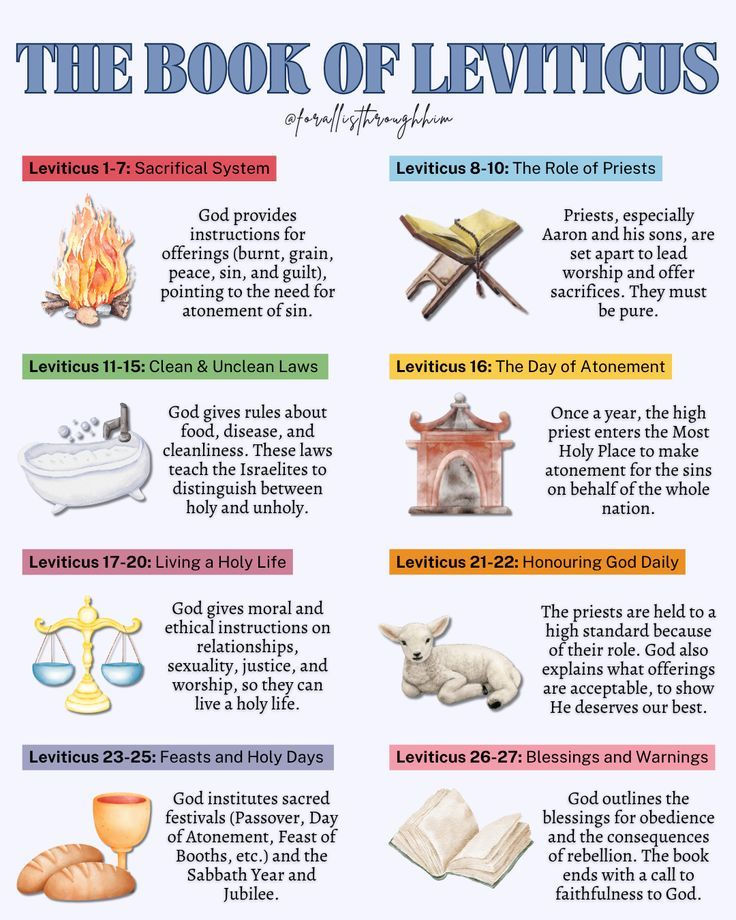
Leviticus 1–7: Rules for the Five Major Types of Sacrifice
These chapters explain the different kinds of offerings that Israel could bring to God. They describe how each sacrifice was to be performed and what it meant.

The Five Basic Types of Sacrifice (Leviticus 1–7)
Leviticus describes five main kinds of offerings:
Burnt Offering – entirely given to God
Grain Offering – an offering of produce
Communion (Peace) Offering – shared by God, priests, and people
Purification Offering – for unintentional sins and ritual impurity
Reparation Offering – for offenses requiring restitution
Leviticus 8–10: Narrative Section
8:1–9:21 describes the consecration (ordination) of Aaron and his sons as priests and the dedication of the Tabernacle.
9:22–24 recounts how Aaron and Moses bless the people and how the LORD visibly appears by sending fire to consume the sacrifice on the altar.
Chapter 10 tells the story of Aaron’s sons who commit serious ritual mistakes.
Leviticus 11–16: Ritual Purity and Atonement
These chapters explain clean and unclean foods, bodily impurities, and how impurity affects the community and the sanctuary. They culminate in Leviticus 16, which gives the detailed ritual for the Day of Atonement (Yom Kippur, the birthday of Edith Stein).
Leviticus 17–26: The Holiness Code
This section focuses on how Israel is called to live as a holy people in every aspect of life.
Leviticus 27: Vows and Dedications
The final chapter deals with promises and offerings made voluntarily to the LORD.
Sacrifice and the Beginning of Israel’s Ritual Life
The laws about sacrifice are given before the priests actually begin offering sacrifices in the Tabernacle. This shows that worship must follow God’s instructions, not human invention.
When the priests finally offer the sacrifices and bless the people, the LORD responds by sending fire from heaven to consume the offering. For the priestly writers of Leviticus, this moment is extremely important: it marks the official beginning of Israel’s ritual system and symbolically completes creation. God now dwells among His people in an ordered, holy way.
However, this sacred moment is immediately followed by tragedy. Two of Aaron’s sons offer unauthorized fire, breaking the ritual rules commanded by God. Fire again comes from the LORD—but this time it consumes them. Their deaths show how serious priestly responsibility is. Even Aaron’s remaining sons later make mistakes and are sharply rebuked by Moses.
These events teach that worship requires careful obedience. They also explain why rituals of purification are needed. Human failure, whether moral or ritual, causes pollution that affects not only people but even the sanctuary itself. This leads to the need for the Day of Atonement, when the Tabernacle is cleansed so God can continue to dwell among Israel.
Ritual Purity and the Day of Atonement
Leviticus 11–15 explains many sources of ritual impurity, such as certain foods, diseases, and bodily conditions. These laws are not about sin in the moral sense but about maintaining proper order and holiness in God’s presence.
Leviticus 16 brings these themes together in the ritual of the Day of Atonement. On this day, the high priest performs a series of sacrifices to purify the sanctuary, the priests, and the people. This annual ritual restores the relationship between God and Israel and allows worship to continue.
The Holiness Code (Leviticus 17–26)
The second half of Leviticus emphasises holiness in everyday life.
Blood and Reverence for Life (Leviticus 17)
The Holiness Code begins with a unique explanation for why Israelites must not eat blood. Blood represents life, which belongs to God alone. Respecting blood is a way of honouring God as the giver of life.
Holiness of the People (Leviticus 18–20)
These chapters explain how all Israelites—not just priests—are called to holiness. They cover moral behaviour, family life, justice, and faithfulness to God.
At the centre is Leviticus 19, often called the heart of the Holiness Code. It functions like a “second Ten Commandments” and includes the command:
“You shall love your neighbour as yourself.” This verse later becomes central in Jesus’ teaching.

Holiness of Priests and Sacrifices (Leviticus 21–22)
These chapters return to rules for priests and sacrificial animals, emphasizing that those who serve God and what is offered to Him must reflect His holiness.

Sacred Time and Continuous Worship (Leviticus 23–24)
Leviticus 23 lays out the calendar of sacred feasts, including Passover, Pentecost, and the Day of Atonement. These holy times structure Israel’s year around God’s saving actions.
Wine offered to God by pouring it out, not by drinking it often accompanied sacrifices, symbolizing life and joy. In the Old Testament sacrificial system, wine was poured on or near the altar along with animal or grain sacrifices. This action was an act of worship, just like offering an animal or grain.
Wine symbolised life, vitality, and joy, because it comes from grapes and brings gladness to human life.
Pouring out wine acknowledged that life itself comes from God and belongs to Him.
The act expressed gratitude and dependence on God’s blessings.
Why wine was used
Wine was widely available in Israel.
Scripture calls wine the “blood of the grape” (Deuteronomy 32:14), linking it symbolically to life.
Unlike some neighbouring cultures that used beer, Israel used wine to reflect its own land, agriculture, and theology.
How it functioned in worship
Wine libations did not replace sacrifices; they accompanied them.
They completed the offering, much like prayer completes action.
Because the ritual was simple, Scripture does not give detailed instructions for how to pour the wine.
Leviticus 24 describes two ongoing rituals: the continual lamp and the bread of the Presence. These symbolize God’s constant presence and care.
A short narrative then stresses the seriousness of honouring God’s name.
God as Owner of Land and People (Leviticus 25–26)
Leviticus 25 teaches that the land belongs to the LORD. The sabbatical year and jubilee year ensure that land sales are temporary and that social justice is preserved.
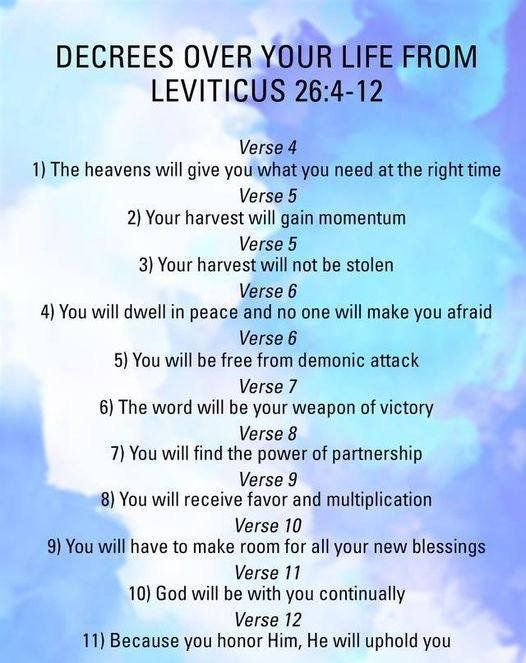
Leviticus 26 concludes with a powerful exhortation. Faithfulness to the covenant brings blessing and prosperity in the land; unfaithfulness brings hardship. Even so, God promises renewal if the people repent.
Vows and Dedications (Leviticus 27)
The final chapter addresses situations in which people dedicate money, property, or persons to the LORD. These rules ensure that vows are treated seriously and fairly.

Sacrifice in the Old Testament
In the Old Testament, “sacrifice” includes many kinds of offerings, such as animals, grain, and wine. Some offerings are completely given to God, while others are shared by priests and worshipers.
Sacrifice served social and religious purposes. Insights from anthropology and comparisons with other ancient Near Eastern cultures help scholars understand how sacrifice functioned in Israel.
Prophetic Criticism of Sacrifice
Some Israelites mistakenly believed that offering sacrifices allowed them to ignore justice and morality. The prophets strongly opposed this idea. For example, Isaiah speaks in God’s name to say that sacrifices without righteousness are meaningless.
These prophetic critiques do not reject sacrifice itself. Instead, they insist that ritual worship must go hand in hand with obedience, justice, and faithfulness to the covenant.
Sacrifice as a Gift in God’s Presence
A key idea for understanding biblical sacrifice is that it functions as a Gift offered to God. In the ancient world, when a person entered the presence of a king or deity, this was called an “audience.” The visitor would bring a gift, bow, and show respect.
Temple worship in Israel follows this pattern. Sacrifice is not a payment or bribe. Rather, it is a sign of humility, loyalty, and dependence on God. Because God gives life, protection, and blessing, the gift offered in sacrifice is always small by comparison. It expresses trust in God’s mercy and generosity.
Many psalms describe worship in these terms, showing that sacrifice is part of entering God’s presence with reverence and praise.

The Priestly Sacrificial System
The priestly writings of the Pentateuch describe sacrifice in a precise and technical way. Some Hebrew words take on specific meanings. For example, minḥah always means a grain offering in priestly texts, even though it can mean “Gift” elsewhere.
Although Israel’s sacrificial system shares similarities with those of neighbouring cultures, it is distinct because of its deep connection to Israel’s beliefs about holiness, sin, purity, sacred space, and sacred time.


Comments